


Chakana: The Meaning of the Inca Cross (Andean Cross)
The chakana, or Andean cross, is a stepped cross with four equal arms, and its name is Quechua for a bridge or stairway. The motif is far older than the Incas and appears at Chavín and Tiwanaku. Popular meanings, such as the three worlds and the Southern Cross, are mostly modern interpretations.
You will see the chakana on pendants and textiles all over Cusco. Here is what the evidence shows and where to see the real thing.
What is the chakana?
The chakana is a cross with four equal arms, each edged with steps. Today it is usually drawn with a square or circle cut out of the centre. You will also hear it called the Andean cross, the Inca cross or the stepped cross.
The name comes from Quechua. In Cusco Quechua, chakana means a bridge or stairway: chaka (bridge) plus -na, a suffix for the tool that does a job. Quechua star lore uses the word too, naming Orion Hatun Chakana (big cross) and the Southern Cross Huch’uy Chakana (small cross).
What does the chakana mean?
Some meanings rest on archaeology or colonial records, while others were added in recent decades. The table shows which is which.
| Element | Common interpretation | How well documented |
|---|---|---|
| Stepped cross shape | A sacred Andean symbol | Well documented as a motif for thousands of years. Its original meaning was never recorded. |
| The name “chakana” | A bridge or ladder between worlds | Genuine Quechua word. Whether the Incas used it for this symbol is debated. |
| Three steps on each arm | Hanan Pacha, Kay Pacha and Ukhu Pacha (upper, this and inner world) | The terms exist in colonial Quechua. Linking them to the steps is a modern reading. |
| Condor, puma and serpent | One animal for each world | All three mattered in the Andes. The one-animal-per-world scheme is a modern teaching aid. |
| Four arms | Four directions, four elements or the four suyus (regions) of the Inca Empire | Interpretation only. |
| Central hole | Cusco, the “navel” of the empire, or a doorway between worlds | Popular modern interpretation. |
| Twelve outer corners | The 12 months of the year | Popular modern interpretation. |
| Overall design | A picture of the Southern Cross constellation | Proposed by Carlos Milla Villena in 1983 and widely repeated. Not proven. |
Art historian Jessica Joyce Christie, who studies Inca carved rocks, accepts the Incas may have shared some of these ideas. But she calls the New Age readings of the corners and steps speculative and unsupported by historical sources.
The three worlds and their animals
The best-known reading says the three steps on each arm stand for three levels of the universe. Hanan Pacha is the upper, celestial world of stars and gods. Kay Pacha is this world of people, animals and plants, and in popular versions the realm of Pachamama, Mother Earth.
Ukhu Pacha is the inner or lower world, linked to death and the ancestors. In the popular version, the Andean condor stands for the upper world, the puma for this world and the serpent for the world below. The Smithsonian’s National Museum of the American Indian notes that Cusco itself was shaped like a puma.
We have not found the tidy condor–puma–serpent ladder in Inca-era sources, so treat it as a modern way of teaching. Even the three-world model is debated. Early colonial writers used hanan pacha and ukhu pacha for the Christian heaven and hell.
Linguist Rodolfo Cerrón-Palomino links these compounds to missionaries. Scholars such as Nathan Wachtel, on the other hand, see a real three-part Andean cosmos in Guaman Poma’s work. For the bigger picture, read our guide to Inca cosmology.
The chakana and the Southern Cross
Many websites say the chakana is a picture of the Southern Cross. This idea was set out by the Peruvian architect Carlos Milla Villena in Génesis de la cultura andina, published in Lima in 1983.
Milla argued that the constellation gave Andean builders a “square cross” and a system of proportions based on a square and its diagonal. Later writers, such as Alfredo Lozano in a 1996 book published in Quito, built on his work. From there the idea spread into guidebooks.
Andean people certainly watched this part of the sky. In Inca star lore, the dark Coalsack nebula beside the Southern Cross is a partridge. Anthropologist Tom Zuidema suspected the constellation played a role in the Inca calendar but could not confirm it.
You will also read that the Southern Cross forms a perfect cross on 3 May. That date is the Catholic feast of the Holy Cross, or Cruz de Mayo, a European celebration that arrived with the Spanish.
Is the chakana really Inca?
The stepped cross is not an Inca invention. It is much older, and the Incas inherited it from a long line of Andean cultures.
- Around 4,000 years ago: in 2023, a San Marcos University team reported a complete chakana in a mud frieze. It was found at Miraflores, in the Chancay Valley near Huaral.
- Around 3,000 years ago: the Tello Obelisk from Chavín de Huántar carries the motif.
- AD 500–900: Tiwanaku, near Lake Titicaca, was at its peak. Its seven-level Akapana platform has a plan often described as half an Andean cross.
- Textiles: Wari and Tiwanaku weavers used crosses and stepped triangles, as on four-cornered hats in New York’s Metropolitan Museum of Art.
Archaeologist Alan Kolata calls the stepped cross one of the most common yet least understood Tiwanaku designs. Scott Smith reads it as a bird’s-eye view of a platform mound. Rock-art researcher Maarten van Hoek links stepped designs to the sacred mountain.
Much later, the Chimú of Peru’s north coast wove stepped crosses into a ceremonial costume. The Museo Chileno de Arte Precolombino says their alternating colours “could be related to the idea of duality”.
The chronicler Garcilaso de la Vega wrote that the Incas kept a square jasper cross in a sacred place in Cusco. He says he left it in the sacristy of Cusco’s cathedral in 1560. He does not describe steps, and he does not call it a chakana.
So the shape is genuinely ancient and Andean. The name, the detailed symbolism and the Southern Cross link are largely modern layers. Some scholars even call today’s chakana an “invented tradition”, in the sense used by historians Hobsbawm and Ranger.
Where to see the chakana in Cusco and Machu Picchu
You will not find signs saying “chakana here”. What you will find are stepped carvings, reliefs and drawings that guides link to the symbol.
Qorikancha, Cusco
The Qorikancha was the most important temple of the Inca Empire, dedicated to the sun. The Spanish built the church and convent of Santo Domingo on top of it. Its Inca walls survived the earthquakes that badly damaged the church above.
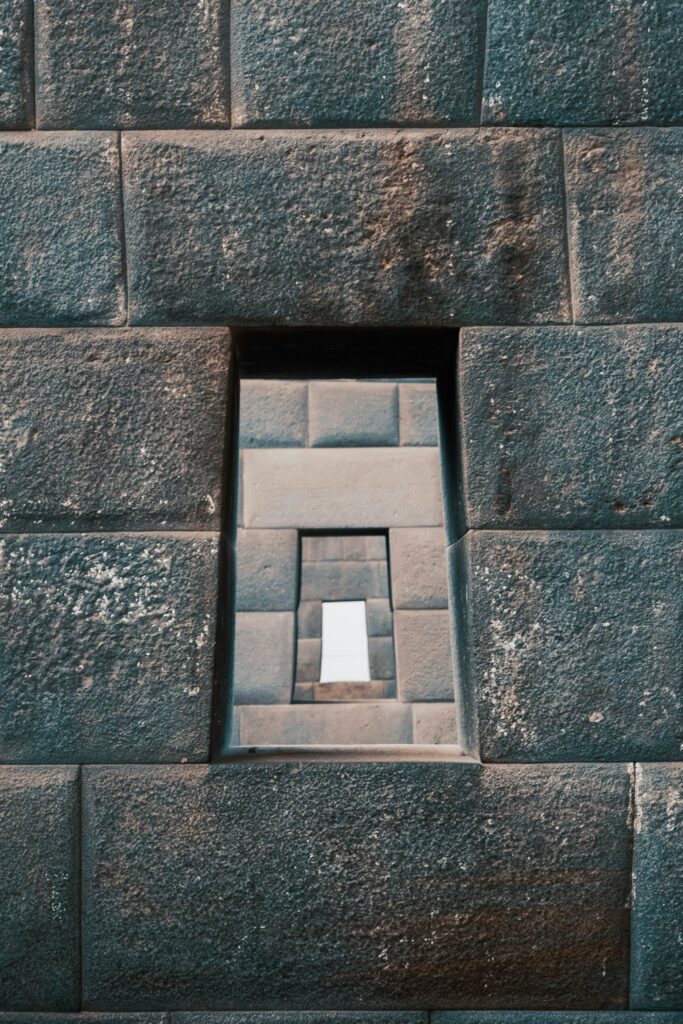
There is no famous carved chakana here. The link is a drawing made around 1613 by the indigenous chronicler Juan de Santa Cruz Pachacuti Yamqui. It shows the sun, moon, stars and other objects he said were venerated in the Qorikancha, and some chakana writers draw on it.
Our Cusco City Tour visits the Qorikancha, Sacsayhuamán and Q’enqo with a bilingual guide.
Q’enqo and Sacsayhuamán
Q’enqo, just above the city, is a rock shrine with a carved altar. Moon’s Cusco guidebook points to chakana-style steps cut into the rock outcrops here and at Sacsayhuamán. Carved outcrops are a signature of Inca art, reflecting belief in a landscape full of sacred forces.
Ollantaytambo
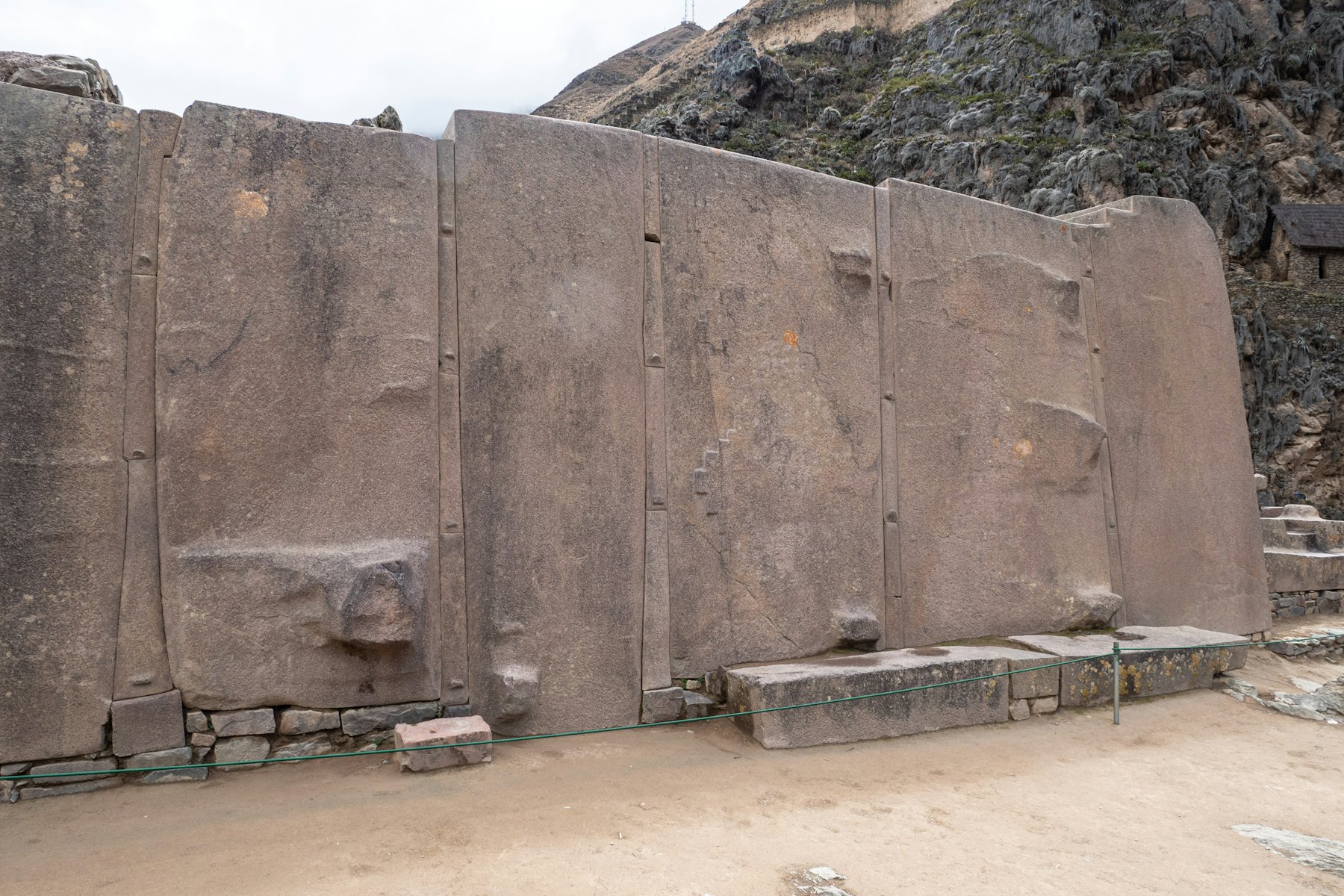
Above Ollantaytambo stands the unfinished Temple of the Sun, a wall of six polished monoliths 3.3 to 4.2 metres tall. Peru’s state news agency Andina notes carved remains of chakanas, rhombuses and feline figures on the stones.
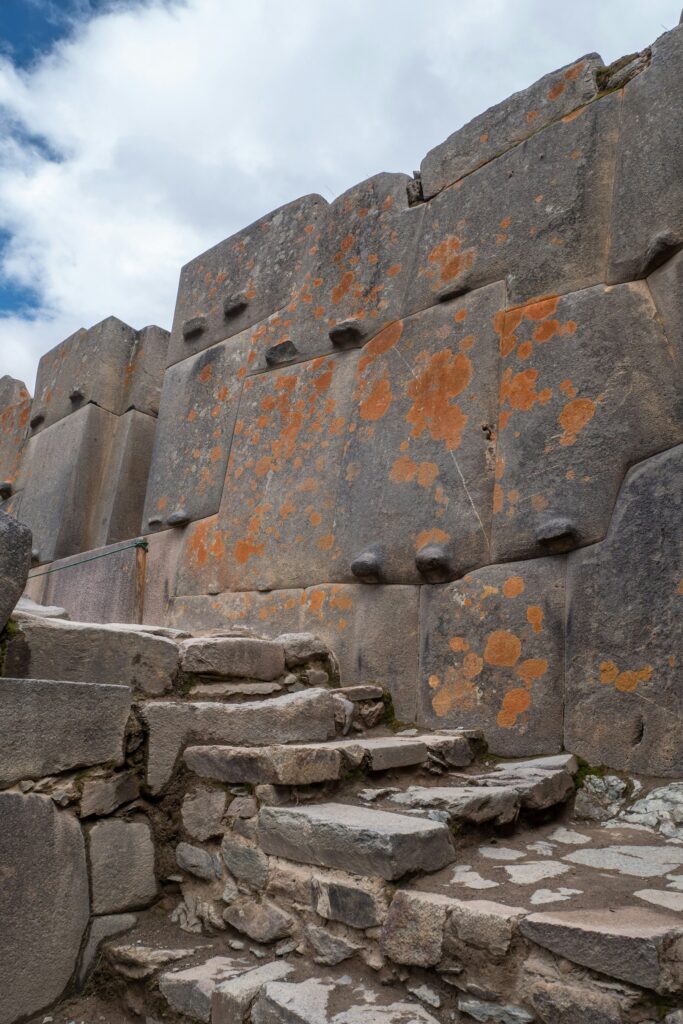
Our Sacred Valley Tour includes guided visits to Ollantaytambo and to the Pisac ruins and market.
Machu Picchu
Moon’s guidebook lists step patterns at the Funerary Rock, the Intihuatana and the so-called Royal Tomb. The Royal Tomb is a cave beneath the Temple of the Sun. Archaeologist Luis Lumbreras describes altars carved into its rock and very fine niches.
Many visitors also look for the Temple of the Condor, named for the bird of the upper world. Since June 2024, visits follow fixed circuits. In 2026, Circuit 3 (Realeza) covers the Temple of the Sun and the Temple of the Condor, so check your circuit before you buy.
Tiwanaku, Bolivia
To see the stepped cross at its ancient source, visit Tiwanaku, a UNESCO World Heritage Site near Lake Titicaca. It sits at 3,850 metres on the Bolivian altiplano. Look for the Akapana, the Kalasasaya and the Gateway of the Sun.
The chakana today (and how to buy one)
The chakana has become a badge of Andean identity. Puno’s coat of arms carries one. In January 2021, Bolivia’s government adopted a new official image built on the Andean cross under Supreme Decree 4445.
In Cusco, the Cruz Velacuy vigil starts on 2 May, when crosses are dressed with flowers. In May 2026, Peru’s Congress radio featured the festival’s sikuri panpipe players as “veladores de la Chakana”, watchers of the chakana. Researchers describe similar May ceremonies in Argentina and Chile where the chakana merges with the Christian cross.
New Age groups and some contemporary spiritual leaders also use the symbol. That is a living tradition, but it is not the same as Inca religion. Stepped designs also run through Andean weaving: see our guides to Inca textile patterns and colours and Inca clothing.
Tips for buying a chakana respectfully
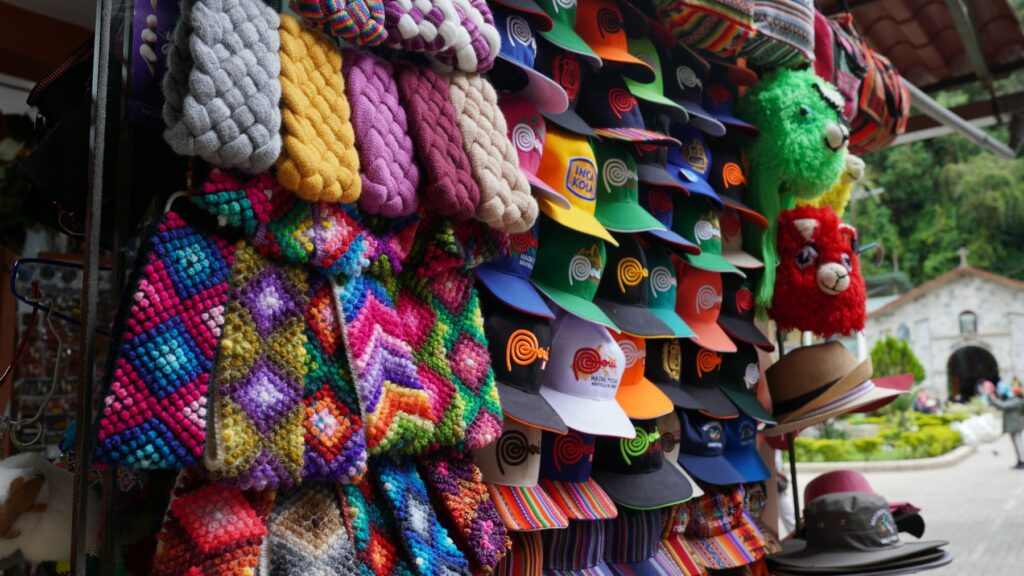
- Buy handmade. The Centro de Textiles Tradicionales del Cusco, founded by Andean weavers in 1996, works with ten weaving communities. Its main shop is next to the Qorikancha.
- Visit Pisac market. It runs daily and is bigger on Tuesday, Thursday and Sunday. Some stock is mass-produced and imported, so ask who made a piece.
- Check the metal. Real silver is usually stamped 925 (sterling, 92.5% silver) or 950, the fineness most Peruvian silver work uses.
- Know what “alpaca silver” means. It is nickel silver, usually 60% copper, 20% nickel and 20% zinc, with no silver at all.
- Mind sensitive skin. Nickel is a common cause of jewellery allergy, especially in earrings.
- Ask about the design. Let the maker explain what it means to them.
See the chakana with a licensed guide
The chakana makes most sense in front of the stones, with someone who can explain them. Our licensed guides can show you Cusco, the Sacred Valley and the Machu Picchu day trip from Cusco. Contact us or message us on WhatsApp at +51 918 885 164 to plan your days.
Chakana: frequently asked questions
What does chakana mean in Quechua?
In Cusco Quechua, chakana means a bridge or stairway. It combines chaka (bridge) with -na, a suffix for the tool that does a job, so it is literally the thing you cross with.
Is the chakana an Inca symbol?
The stepped cross is much older than the Incas. It appears at Chavín, at Tiwanaku and in a roughly 4,000-year-old frieze near Huaral. The Incas used stepped motifs, but most of today’s detailed symbolism is modern.
What do the three steps of the chakana represent?
Popularly, they stand for Hanan Pacha (upper world), Kay Pacha (this world) and Ukhu Pacha (inner world), often with the condor, puma and serpent. Art historian Jessica Joyce Christie calls such readings speculative and unsupported by historical sources.
Where can I see a chakana near Cusco?
Guides point out stepped carvings at Q’enqo and Sacsayhuamán, on the Temple of the Sun monoliths at Ollantaytambo, and at Machu Picchu. For the ancient original, visit Tiwanaku in Bolivia.
Is alpaca silver real silver?
No. Alpaca silver is nickel silver, an alloy of copper, nickel and zinc with no silver in it. For real silver, look for a 925 or 950 stamp.