


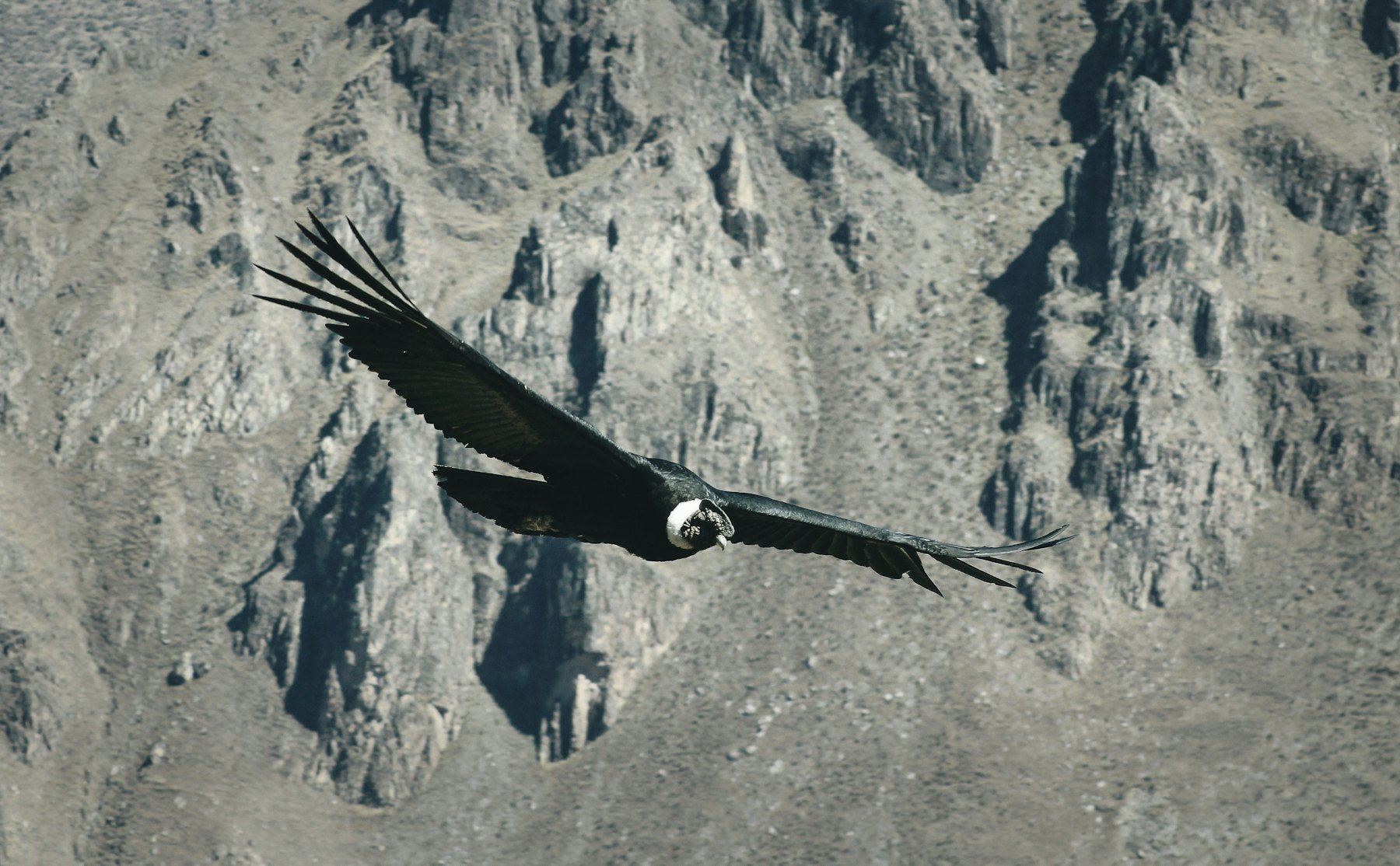
Andean Condor: Facts, Inca Meaning and Where to See It in Peru
The best place to see the Andean condor in Peru is the Cruz del Cóndor viewpoint in Colca Canyon, in the Arequipa region. Arrive between 8 and 10 a.m. in the dry months, roughly April to November, when rising air lifts the birds past the lookout. Near Cusco, try the Chonta viewpoint or the Choquequirao trek.
The condor is Peru’s largest flying bird, and the country’s national conservation plan calls it an ancestral symbol of Andean culture.
Andean condor at a glance
| Fact | Andean condor |
|---|---|
| Scientific name | Vultur gryphus (in Quechua: kuntur) |
| Wingspan | Up to about 3.2 m (10.5 ft) |
| Weight | Males up to 15 kg (33 lb); females up to 11 kg (24 lb) |
| Length | Up to 1.3 m (4.25 ft) |
| Lifespan | About 50 years in the wild; more than 75 in human care |
| Diet | Carrion (dead animals); it can eat over 6.8 kg (15 lb) in one sitting |
| Breeding | One egg every other year; 50–60 days of incubation |
| Range | The Andes from Venezuela and Colombia to Tierra del Fuego; in Peru, also parts of the coast such as Paracas |
| Global status | Vulnerable (IUCN Red List), raised from Near Threatened in 2020 |
| Population trend | Decreasing; no more than about 6,700 mature birds in the wild |
| Status in Peru | Endangered (Supreme Decree 004-2014-MINAGRI); at least 301 birds counted in the 2022 national census |
How big is the Andean condor?
Very big. Its wingspan reaches about 3.2 m (10.5 ft), making it South America’s largest flying bird and one of the world’s largest. Males are usually bigger than females and can weigh 15 kg (33 lb).
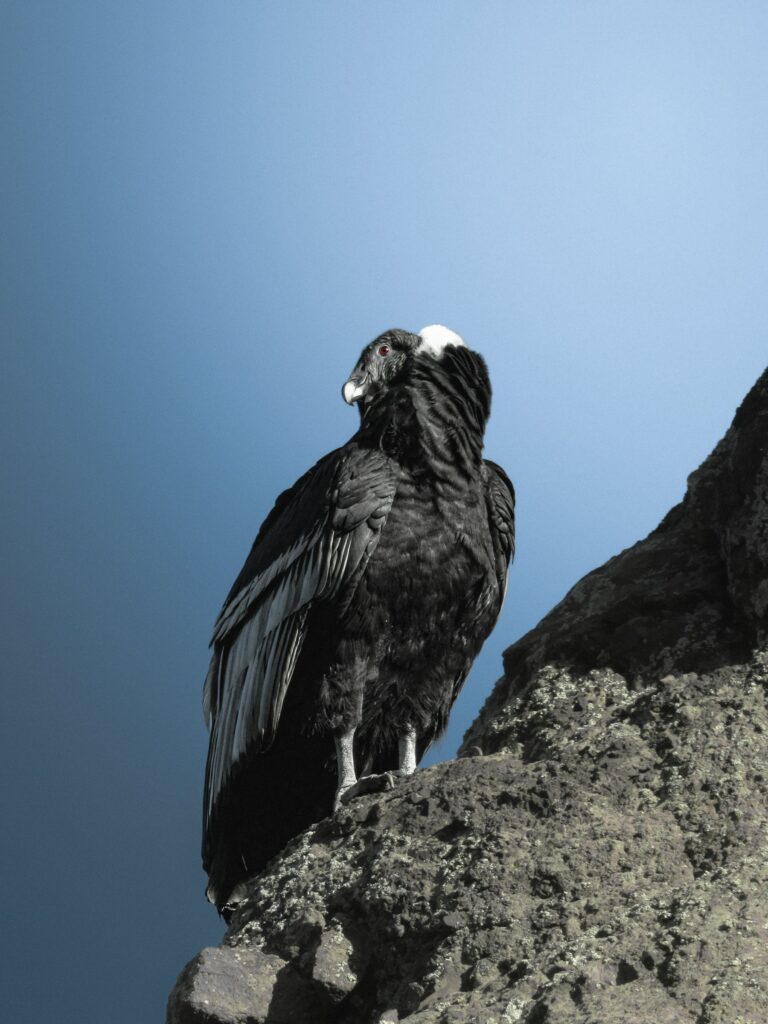
Adults are black, with a white ruff around the neck and white patches on the wings. Like other vultures, they have a bare head, which stays clean while they feed. Males carry a fleshy comb and have brown eyes; females have no comb and red eyes.
A bird this heavy saves energy by riding rising warm air, called thermals. Condors can soar to about 5,500 m (18,000 ft), and one tracked bird flew more than 160 km (100 miles) without flapping.
They are also very slow breeders. A pair lays one egg every other year, and the chick depends on its parents for about a year and a half.
What did the condor mean to the Incas?
The condor was sacred in the Andes long before the Incas. It appears in the art of the Chavín, Paracas, Nasca, Wari and Tiwanaku cultures.
For the Incas, the condor belonged to Hanan Pacha, the upper world of the sky. Guides often explain Inca cosmology with three animals. The condor stands for Hanan Pacha, the puma for Kay Pacha (this world) and the serpent for Uku Pacha (the world below).
Treat that neat trio as a summary rather than a rulebook. The Incas left no written texts on their beliefs, so our picture comes from Spanish chroniclers, archaeology and living tradition. The trio also leaves out other great powers, such as Pachamama, Mother Earth.
That living tradition is strong. In many Quechua and Aymara communities, the condor is seen as the messenger of the apus, the spirits of the mountains. Some people say that killing one brings a curse.
The Temple of the Condor at Machu Picchu
The most famous condor at Machu Picchu is made of stone. At the Temple of the Condor, natural rock outcrops were shaped to suggest outspread wings, with a carved head on the ground below.
The temple is included on Circuit 3 and on the official map for Route 2-A, so check your ticket’s route. Our guide on how to get to Machu Picchu covers the rest of the trip.
Where can you see condors in Peru?
Peru’s first national condor census, in 2022, counted at least 301 birds across 16 regions. The highest counts came from Ayacucho (77), Arequipa (62), Apurímac (36) and Cusco (23). For travellers, the places below are the most practical.
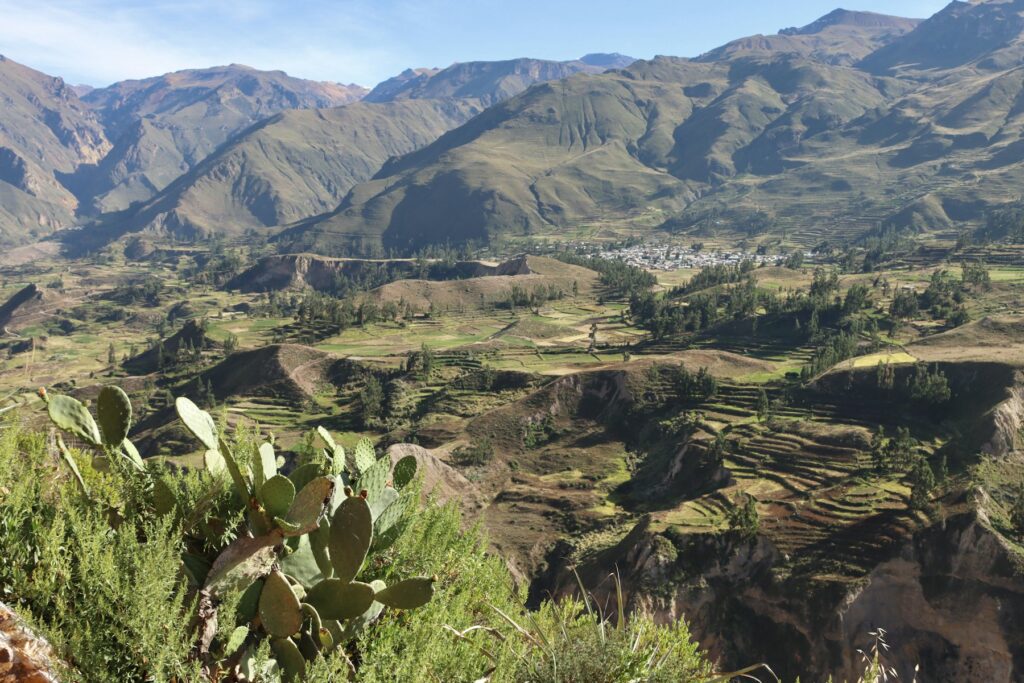
Cruz del Cóndor, Colca Canyon (Arequipa)
This is Peru’s classic condor viewpoint. It sits about 50 km west of Chivay, above a drop of around 1,200 m to the Colca River. Condors nest on the nearby cliffs and glide past the lookout on rising air.
Expect company: in season, a couple of hundred people gather for the morning flights. You also need the Colca tourist ticket (boleto turístico), around S/70 (about US$20) for foreign visitors at the time of writing.
Our Colca Canyon tour from Arequipa (1 day) leaves in the small hours to reach the viewpoint in the morning. The tourist ticket is not included and is bought in the valley.
Chonta viewpoint, near Limatambo (Cusco)
Chonta is the best-known condor viewpoint within reach of Cusco. It overlooks the Apurímac canyon in Limatambo district, Anta province, at about 3,400 m.
Turn off the Cusco–Abancay highway near kilometre 80, then drive about 18 km of dirt road to the ticket booth. From there it is a walk of about 3.5 km to the lookout. The condors perch on the cliffs naturally, and afternoons, roughly 1:00 to 4:30 p.m., give the best chance.
The Apurímac canyon on the Choquequirao trek
The same canyon frames the Choquequirao trek. From Capuliyoc (about 2,890 m), the trail drops to the river at around 1,500 m. It then climbs to the ruins at about 3,050 m.
Condors ride the canyon’s air currents, and trekkers sometimes spot them on the descent or around the site. Sightings are never guaranteed, but few places offer condors and Inca ruins on the same day.
Machu Picchu and the Sacred Valley
Peru’s condor plan lists the Machu Picchu Historic Sanctuary and the Ollantaytambo–Abra Málaga area among the species’ homes in Cusco. Still, a condor over the citadel is a lucky bonus, not something to plan around. Our guide to animals in Machu Picchu covers what you are more likely to see.
Rescued condors at Ccochahuasi
To see a condor up close, visit the Ccochahuasi animal sanctuary (also spelled Cochahuasi), at about kilometre 22 of the Cusco–Pisac road. It has cared for injured condors brought in by SERFOR, Peru’s forest and wildlife service, and the police.
In 2019 a condor named Marcapata Kuntur went back to the wild with a GPS tracker after two years of care there. He had been rescued with a broken leg after a Yawar Fiesta.
| Place | Region | Best time | What to expect |
|---|---|---|---|
| Cruz del Cóndor | Arequipa (Colca Canyon) | 8–10 a.m., dry season | Wild condors at close range; crowds in season |
| Chonta viewpoint | Cusco (Limatambo) | About 1:00–4:30 p.m. | Wild condors on the cliffs; 3.5 km walk each way |
| Choquequirao trek | Cusco and Apurímac | Any time on the trail | Possible sightings over the Apurímac canyon |
| Machu Picchu | Cusco | During your visit | Sightings rare; the stone Temple of the Condor is certain |
| Ccochahuasi sanctuary | Cusco (Cusco–Pisac road) | Opening hours | Rescued condors seen up close |
When is the best time to see condors?
Time of day matters more than the month. Condors need rising air to get airborne, so they wait for the sun to warm the canyon.
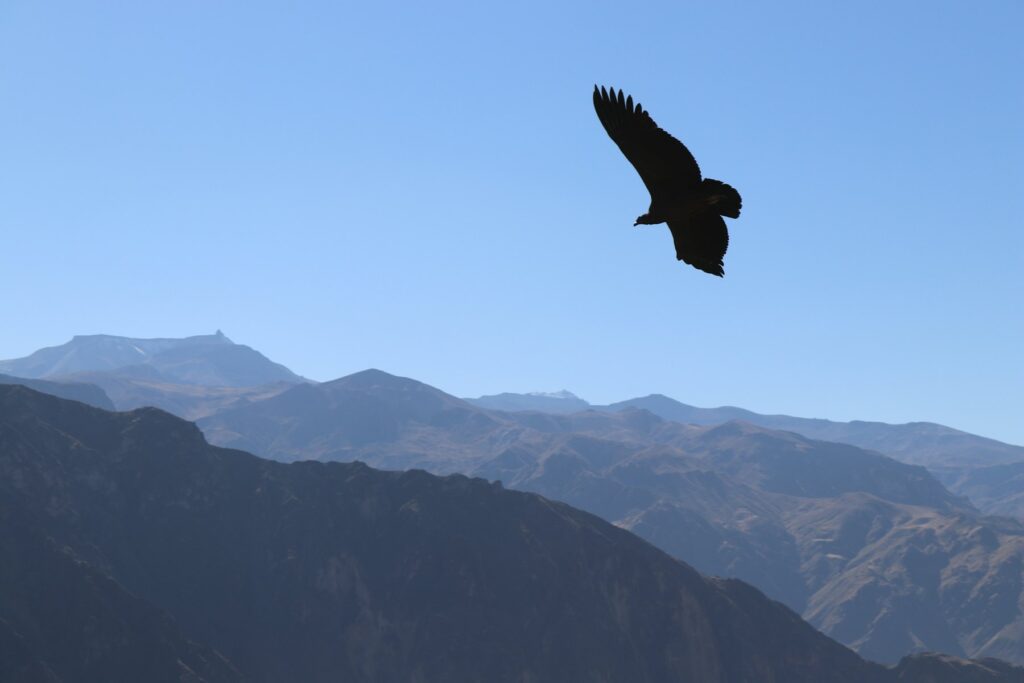
At Cruz del Cóndor, the main window is about 8 to 10 a.m. A smaller second session often comes around 3:30 to 4:30 p.m., with fewer people. Midday visits rarely pay off.
Condors live in Colca all year, but the dry season is more reliable. June to September tends to bring the biggest groups in flight. In the heart of the rainy season, January and February, sightings drop sharply.
Is the Andean condor endangered?
Globally, the Andean condor is listed as Vulnerable on the IUCN Red List. BirdLife International raised it from Near Threatened in the 2020 update, after rapid declines.
No more than about 6,700 mature birds remain in the wild. Numbers are lowest in the north, where perhaps 340 survive in Colombia, Ecuador and Venezuela.
In Peru, the condor is officially Endangered under Supreme Decree 004-2014-MINAGRI. The national plan estimated fewer than 2,500 birds, and the 2022 census counted a minimum of 301.
What threatens condors?
- Poisoning. Poisoned carcasses set out for livestock predators kill condors too. A 2022 study found it was the main cause of injury and death.
- Lead. Condors swallow lead shot and bullet fragments in carcasses, which slowly poisons them.
- Shooting and capture. Some are shot, and others are caught alive for festivals or for the trade in feathers and bones.
- Power lines and wind farms. Collisions and electrocution add to the losses.
Because a pair raises one chick every two years, each adult lost is hard to replace. SERFOR rescues and rehabilitates injured birds; by 2023 it had released three rehabilitated condors in Arequipa alone.
The Yawar Fiesta
The Yawar Fiesta is a festival in some Andean communities in which a wild condor is tied to the back of a bull. Peru’s condor plan records more than 40 cases of condors captured alive for it, mainly in Apurímac.
The plan aims to steer the festival toward tourism and conservation. Meanwhile, capturing or trading protected wildlife is a crime under Article 308 of Peru’s Penal Code. In 2024 a Cusco court gave two people suspended four-year sentences for capturing and mistreating a condor at a 2017 festival.
How to watch condors responsibly
- Keep your voice down. Condors pass close to the Cruz del Cóndor lookout, and a calm crowd gets the best views.
- Stay behind barriers and on paths. Several viewpoints sit on the edge of sheer cliffs.
- Leave the drone in your bag. A drone among soaring condors can stress the birds or hit one.
- Never feed or bait condors. Choose viewpoints where the birds are not lured with carrion.
- Don’t buy condor feathers, bones or “amulets”. The trade is illegal and fuels hunting.
- Skip shows with captive condors. Avoid festivals or photo stops where a condor is tied up or handled.
- Report problems. If you see an injured or captive condor, message SERFOR’s “Alerta Serfor” WhatsApp line on +51 947 588 269 (weekdays, office hours).
- Pack binoculars and layers. Early starts at altitude are cold, and binoculars help when the birds circle wide.
See Andean condors with Happy Gringo Tours
On our 2-day Colca Canyon tour, our licensed guides take you to Cruz del Cóndor after a night in Chivay. To combine condors with Machu Picchu or a trek, contact us or message us on WhatsApp at +51 918 885 164.
Andean condor: frequently asked questions
Where is the best place to see condors in Peru?
Cruz del Cóndor in Colca Canyon, Arequipa, is the most reliable spot. Near Cusco, the Chonta viewpoint and the Choquequirao trek, both above the Apurímac canyon, are good alternatives.
What time do condors fly at Colca Canyon?
Mostly between about 8 and 10 a.m., when rising air lets them soar. A smaller afternoon session can happen around 3:30 to 4:30 p.m.
Is the Andean condor endangered?
It is Vulnerable on the IUCN Red List, raised from Near Threatened in 2020. In Peru it is officially classed as Endangered.
How big is an Andean condor’s wingspan?
Up to about 3.2 m (10.5 ft). Males can weigh up to 15 kg (33 lb), which makes it one of the largest flying birds in the world.
Can you see condors at Machu Picchu?
Condors live in the Machu Picchu Historic Sanctuary, but seeing one there is down to luck. You can always visit the Temple of the Condor, a stone carving on Circuit 3.
Why was the condor sacred to the Incas?
The Incas linked the condor with Hanan Pacha, the upper world of the sky. In Andean belief today, it is also the messenger of the apus, the mountain spirits.