


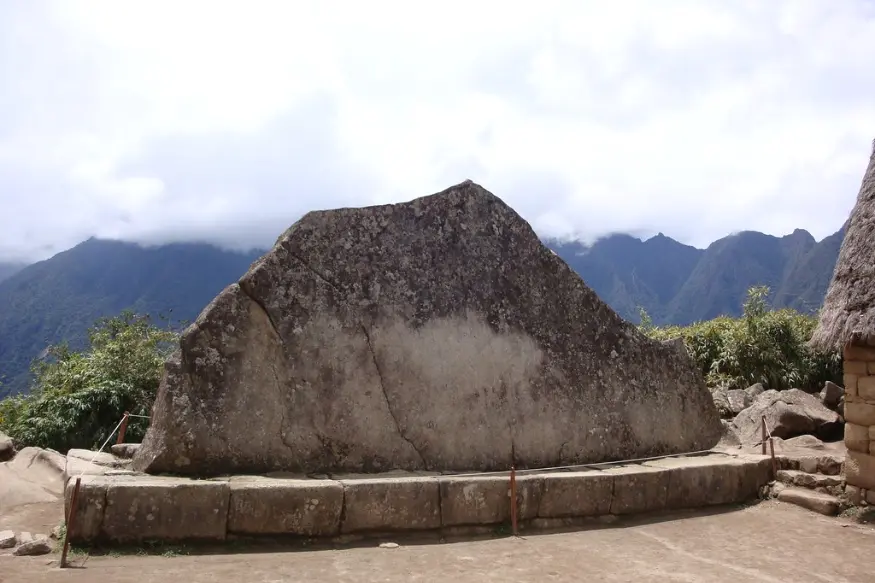
Sacred Rock at Machu Picchu
The Sacred Rock at Machu Picchu is one of the most mysterious and spiritually charged monuments within the Inca citadel. While most visitors are drawn to its temples, terraces, and panoramic views, few truly understand the meaning behind this enigmatic stone that has stood silently for centuries.
This massive carved boulder is not just another archaeological feature — it embodies the profound spiritual connection that the Incas maintained with their natural surroundings. The Sacred Rock represents a union between architecture, geography, and cosmology, reminding us that for the Incas, the landscape itself was alive and sacred.
In this complete guide, we will explore its history, location, symbolism, and practical information for travelers who wish to visit and understand the Sacred Rock at Machu Picchu in depth.

What Is the Sacred Rock at Machu Picchu?
The Sacred Rock at Machu Picchu (known in Spanish as La Roca Sagrada) is an enormous monolith located in the northern sector of the Inca citadel, near the entrance to the Huayna Picchu Mountain. The stone measures approximately 7 meters (23 feet) wideand 3 meters (10 feet) high, and is set upon a carved platform surrounded by low stone walls.
At first glance, the Sacred Rock may seem like a simple large boulder. However, its deliberate shape, orientation, and positioning reveal its importance as a ritual and symbolic monument. The Incas did not carve stones randomly; they shaped them to align with the surrounding mountains, which they considered deities or apus.
It is widely believed that the upper outline of the Sacred Rock mirrors the silhouette of the mountain Yanantin, located directly behind it. This visual harmony between human craftsmanship and nature perfectly captures the Inca concept of sacred geography.
History and Origin of the Sacred Rock
Discovery and Early Research
The Sacred Rock at Machu Picchu was first documented in 1911 by Hiram Bingham, the American explorer credited with rediscovering Machu Picchu. In his field notes, Bingham referred to it as “a great ceremonial stone” and noted its unique location and orientation within the site.
Unlike the finely polished stones of temples such as the Temple of the Sun or the Intihuatana, the Sacred Rock is left mostly in its natural form — a clear sign that the Incas viewed it as a living part of the mountain rather than a man-made object.

The Inca Philosophy Behind Its Creation
The Incas believed that every element of nature had spiritual energy, known as camay. Mountains, rivers, rocks, and even wind were manifestations of divine forces. Stones such as the Sacred Rock were revered as wak’as — sacred objects that served as bridges between humans and the gods.
The Sacred Rock may have been carved and consecrated during the reign of Pachacútec, the visionary Inca emperor who ordered the construction of Machu Picchu around the mid-15th century. Archaeologists suggest that this area was part of a ceremonial route, where priests and pilgrims made offerings to honor the spirits of the mountains and the earth.
Location and How to Reach the Sacred Rock
Where Is the Sacred Rock Located in Machu Picchu?
The Sacred Rock stands in the northernmost section of the Machu Picchu citadel, close to the checkpoint for the Huayna Picchu Mountain trail. It is part of the Sacred Plaza area, an important religious and ceremonial zone within the Inca complex.
This location is not coincidental. The rock sits at the intersection of several energy lines and faces the mountain Yanantin, believed to be its spiritual counterpart. The Incas often positioned sacred stones to “reflect” the shape of nearby peaks, symbolically uniting heaven and earth.
How to Get There
Enter Machu Picchu through the main control gate.
Follow the established visitor route toward the Sacred Plaza and Temple of the Three Windows.
Continue walking north along the Huayna Picchu access path.
After a few minutes, you will arrive at a small open area where the Sacred Rock at Machu Picchu rests, enclosed by low stone walls.
It takes around 20 to 25 minutes to reach the Sacred Rock from the entrance gate, depending on your pace and the visitor circuit you choose.
Cultural and Spiritual Importance of the Sacred Rock
A Portal Between Worlds
For the Incas, the Sacred Rock at Machu Picchu was more than a piece of geology — it was a spiritual portal. The Incas believed the rock served as a connection between the three levels of existence:
Hanan Pacha (the upper world) – the realm of gods and celestial beings.
Kay Pacha (the earthly world) – where humans and animals live.
Ukhu Pacha (the inner world) – associated with ancestors and the spirit of the earth.
By venerating the rock, priests and pilgrims sought balance between these realms, ensuring fertility, prosperity, and cosmic order.
The Alignment with Sacred Mountains
The Sacred Rock faces Mount Yanantin, one of the many peaks surrounding Machu Picchu. In Andean belief, mountains were living deities or apus, and this alignment symbolized communication between the sacred mountain and the people below.
Researchers have also observed that the rock’s orientation allows it to receive direct sunlight during certain times of the year, particularly around the solstices. This suggests that the site may have also served astronomical purposes, helping the Incas track seasonal changes for agricultural planning.
Ceremonial Use
Archaeological studies indicate that the area around the Sacred Rock was likely a ritual gathering space. The platform in front of it could have been used for offerings, chants, or coca-leaf ceremonies performed by priests and nobles.
Because of its proximity to the Huayna Picchu trail, some scholars believe the rock marked a spiritual checkpoint for pilgrims before ascending the mountain, which was also considered a sacred site.
Architecture and Design of the Sacred Rock
The Sacred Rock at Machu Picchu displays both natural and human craftsmanship. While its general shape follows the mountain’s natural contours, the Incas carefully carved its base to rest on a polished stone platform.
This attention to detail demonstrates the Inca principle of architectural duality — combining nature’s perfection with human order.
Dimensions and Structure
Height: Approximately 3 meters (10 feet)
Width: About 7 meters (23 feet)
Shape: The upper outline mirrors the mountain Yanantin
Surroundings: Enclosed by a small plaza and retaining walls
Unlike other monuments such as the Intihuatana Stone, the Sacred Rock does not contain carved niches or astronomical angles. Its simplicity underscores its role as a natural huaca — a sacred element venerated for its intrinsic energy rather than its sculptural detail.
Symbolism of the Sacred Rock at Machu Picchu
The Sacred Rock embodies several layers of symbolism that reflect the Inca worldview:
Union with Nature: Its outline mirrors the mountain behind it, showing respect for the natural world.
Duality (Yanantin): In Quechua philosophy, yanantin means balance between opposites — masculine and feminine, earth and sky, life and death. The rock’s alignment with Mount Yanantin symbolizes this harmony.
Spiritual Energy: The Incas believed sacred stones could absorb and radiate the energy of the apus, protecting the city and its inhabitants.
Pilgrimage Center: Its location along a ceremonial route suggests it was a place of purification and prayer before entering or leaving the citadel.
Practical Tips for Visiting the Sacred Rock
Access and Visitor Route
The Sacred Rock at Machu Picchu is part of Circuit 3 (Low Route) and also accessible from the Huayna Picchu entrance path. Most guided tours include this stop toward the end of the circuit, right before or after visiting the Temple of the Condor.
To visit it, you must have a valid Machu Picchu entrance ticket — either the standard ticket or the Machu Picchu + Huayna Picchu combination.
Best Time to Visit
Morning (6:00 – 9:00 a.m.): Fewer crowds and clearer visibility for photographs.
Afternoon (3:00 – 4:30 p.m.): Softer light, but mist may form.
Avoid the rainy season (January to March) if possible, as humidity and fog can obscure visibility.
Photography Tips
Use a wide-angle lens to capture both the Sacred Rock and Mount Yanantin in one frame.
The best angle is from the plaza directly in front of the rock.
Tripods are not permitted without special authorization, so handheld photography is recommended.
Etiquette and Preservation
Do not touch or lean on the Sacred Rock.
Remain within designated pathways and barriers.
Avoid loud noises; treat the site with the respect due to a sacred place.
Flash photography is discouraged.
Curiosities and Lesser-Known Facts
The Sacred Rock is sometimes referred to as “The Stone of Yanantin”, referencing its alignment with the mountain of the same name.
Many visitors experience a sense of calm or energy when standing near it, a phenomenon often associated with Andean sacred sites.
The small plaza in front of the rock may have served as an amphitheater for ceremonies, where sound reverberates in a unique way.
The Sacred Rock is one of the few untouched natural monuments in the citadel — it remains almost exactly as the Incas left it.
Some esoteric researchers claim the rock functions as an energetic vortex, connecting Machu Picchu with other sacred sites in the Andes.
The Sacred Rock is often overlooked by visitors rushing to climb Huayna Picchu, yet it offers one of the most serene and spiritually charged spots in the entire site.
Why the Sacred Rock Is a Must-See
Visiting the Sacred Rock at Machu Picchu offers more than a historical lesson — it is a moment to feel the spiritual essence of the Andes. Unlike temples or walls, the rock conveys its meaning through silence, geometry, and presence.
Standing before it, surrounded by mountains and mist, you can sense why the Incas chose this exact location to build their city. The Sacred Rock is not an ornament — it is a reminder that Machu Picchu was conceived as a living organism, where every stone and mountain played a role in maintaining cosmic balance.
For those who visit with an open heart, the Sacred Rock becomes more than a monument — it becomes a mirror of the harmony between humankind and the natural world.
Frequently Asked Questions about the Sacred Rock at Machu Picchu
How can I visit the Sacred Rock?
You can reach it by following the main visitor route toward the Huayna Picchu checkpoint. It is included in most standard tours and accessible with a Machu Picchu or Machu Picchu + Huayna Picchu ticket.
What is the purpose or meaning of the Sacred Rock?
The rock symbolizes the Inca belief in the sacredness of nature and duality. It may have served as a ceremonial altar and a representation of the surrounding mountains’ spiritual energy.
Is the Sacred Rock still used for ceremonies today?
While no formal rituals are performed inside Machu Picchu today, some local guides and Andean shamans continue to honor it symbolically during cultural or spiritual tours.
Can I touch the Sacred Rock?
No. Touching or leaning on the rock is prohibited to preserve its condition. Visitors are asked to maintain a respectful distance.